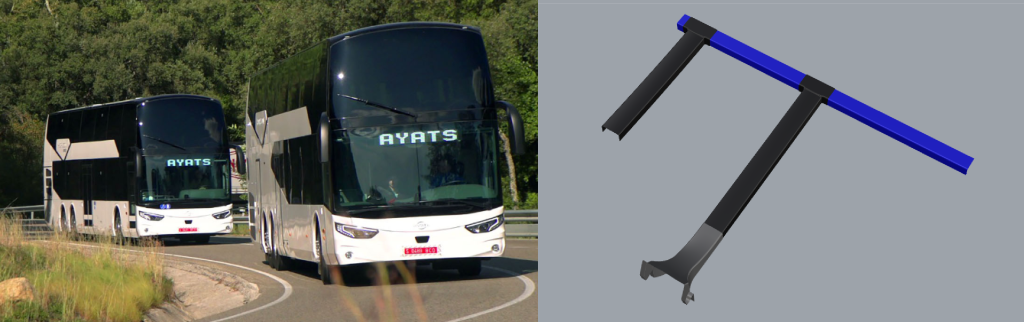

MEL Composites is proud to announce its collaboration with Spanish bus and coach manufacturer Carrocerías Ayats, showcasing the benefits of advanced composite technologies and scalable manufacturing processes originally developed for the sporting goods sector. The joint development of lightweight composite window frame covers demonstrates how MEL's process innovation can be successfully transferred to the transportation industry to meet new regulatory and performance objectives.
As part of Ayats' commitment to reducing vehicle weight in line with evolving EU legislation, the new Rohacryl™ foam covers for window frames, developed with support from MEL Composites, are up to 80% lighter than traditional elastomer foam alternatives. This significant weight reduction directly contributes to increased passenger capacity and overall efficiency.
Carrocerías Ayats, based in Arbúcies (Girona), is a historic leader in the design and manufacture of double-decker buses and coaches, with a presence in over 20 countries. With an innovation record that includes being the first European manufacturer to obtain r.66 tilt test certification for double-decker vehicles, Ayats continues to push the boundaries of vehicle design and performance.
Although traditionally focused on steel and aluminum structures, Ayats saw a unique opportunity in its recent acquisition of Karbon Design, a Barcelona-based carbon paddle racket manufacturer. MEL Composites has supported Karbon Design for over a decade, developing efficient manufacturing techniques that have grown alongside the sport's popularity. This foundation proved highly valuable in adapting processes for automotive-scale applications.
The project began with the analysis of several window frame cover components selected for composite material development. MEL designed custom tooling, including aluminum molds and tooling board, and innovatively combined two distinct pieces into a single mold to enhance manufacturing efficiency. Initial parts were produced using resin infusion with solid laminate and sandwich structures featuring a 1mm Rohacryl™ core (cores were cut internally at MEL Composites). As volumes increase, production is expected to transition to Light RTM molding and press methods. Throughout the collaboration, MEL Composites provided critical technical insight, suggesting improvements in part design, tool surface quality, and manufacturing workflow, guiding Ayats toward a more automated, cost-effective, and scalable production process.
This project is a testament to how composite material technologies proven in other sectors, such as sporting goods, can be adapted to address specific challenges in the automotive industry. It has been a pleasure to work with Carrocerías Ayats to develop lightweight, low-risk components suitable for future automated production. We are excited about the possibility of continued collaboration and expanding composite material integration into their next generation of vehicles.
Eduardo Galofre, CEO of MEL Composites
Eduardo Galofre, CEO of MEL Composites